
- Home
- »
- Healthcare IT
- »
-
Healthcare Analytics Market Size, Industry Report, 2033GVR Report cover
![Healthcare Analytics Market Size, Share & Trends Report]()
Healthcare Analytics Market (2026 - 2033) Size, Share & Trends Analysis Report By Type (Descriptive Analysis, Predictive Analysis), By Component (Software, Hardware, Services), By Delivery Mode, By Application, By End Use, By Region, And Segment Forecasts
- Report ID: 978-1-68038-937-1
- Number of Report Pages: 190
- Format: PDF
- Historical Range: 2021 - 2024
- Forecast Period: 2026 - 2033
- Industry: Healthcare
- Report Summary
- Table of Contents
- Segmentation
- Methodology
- Download FREE Sample
-
 Download Sample Report
Market Size, 2025 (US$B)$65.6B Forecast, 2033 (US$B)$198.8B CAGR, 2026 - 203313.5% Healthcare Analytics Market Summary
The global healthcare analytics market size was estimated at USD 65.6 billion in 2025 and is projected to reach USD 198.8 billion by 2033, growing at a CAGR of 13.5% from 2026 to 2033. This growth is attributed to the increasing challenges, such as inadequate patient care, rising treatment costs, and low levels of patient retention and engagement.

Key Market Trends & Insights
- North America dominated the global healthcare analytics market with the largest revenue share of 47.5% share in 2025.
- The healthcare analytics industry in the U.S. accounted for the largest market revenue share in North America in 2025.
- By type, the descriptive analytics segment led the market with the largest revenue share of 45.4% in 2025.
- By component, the services segment led the market with the largest revenue share of 38.1% in 2025.
- By delivery mode, the cloud based segment is anticipated to register at the fastest CAGR of 46.3% during the forecast period.
- By application, the financial segment accounted for the largest market revenue share in 2025.
- By end use, the life science companies segment led the market with the largest revenue share of 40.6% in 2025.
Market Size & Forecast
- 2025 Market Size: USD 65.6 Billion
- 2033 Projected Market Size: USD 198.8 Billion
- CAGR (2026-2033): 13.5%
- North America: Largest market share in 2025
- Asia Pacific: Fastest growing market
In addition, the complexity of interpreting marketing analytics is driven by the sheer speed, volume, variety, and questionable authenticity of available data, which further complicates decision-making significantly, driving the role of healthcare analytics in the market.
According to an article published by Infosys Limited in December 2022, the healthcare sector currently contributes nearly 30% of the world’s total data volume, and this figure is projected to grow at a strong CAGR of 36% through 2025.
Market Dynamics
The growing volume of patient data from electronic health records (EHRs) and wearable devices is driving the market growth, as it increases the scale and complexity of available health data. EHR systems continuously generate large volumes of structured and unstructured clinical data across care settings, driven by high adoption levels; for instance, the National Electronic Health Records Survey (NEHRS) 2024 reported that 95.0% of U.S. office-based physicians had adopted EHR systems, with 83.6% using certified EHR platforms. In addition, wearable devices and remote monitoring technologies generate high-frequency, real-time physiological and behavioral data, including heart rate, activity levels, sleep patterns, and glucose readings. The convergence of these data streams is creating large, complex datasets that require advanced analytics powered by artificial intelligence and machine learning to derive actionable insights. This enables improved population health management, early disease detection, personalized treatment planning, and proactive care delivery, thereby driving demand for scalable healthcare analytics platforms.
Increasing adoption of big data and AI in healthcare is a key driver for the market growth, as healthcare providers and payers increasingly leverage large volumes of clinical, operational, and patient-generated data to improve clinical decision-making, operational efficiency, and cost management. The integration of AI and advanced analytics enables predictive modeling, population health management, personalized treatment planning, and early disease detection, thereby enhancing care quality and outcomes.
Some of the recent developments in AI-enabled healthcare analytics
Company
Announcement Date
Initiative / Solution
Key Focus & Impact
Oracle
May 2025
Strategic partnership with the Cleveland Clinic and G42 to develop an AI-based global healthcare delivery platform
Aims to improve patient care, public health management, and affordability through advanced AI, data analytics, and clinical expertise.
Oracle
October 2024
Oracle introduced Oracle Analytics Intelligence for Life Sciences, an AI-powered platform designed to help life sciences companies, academic medical centers, health systems, and research institutes derive deeper insights into diseases and their impact on patients.
The solution enables organizations to enhance therapeutic launch strategies by leveraging a pre-built, continuously updated analytics ecosystem that integrates a broad range of real-world data sources, including CancerMPact and multi-omics datasets.
SCOR
October 2024
AI-based predictive engine launched in Vietnam in partnership with Insmart JSC
Enhances underwriting, claims, and operational efficiency in life & health insurance through machine learning and data analytics.
Clarify Health
October 2024
Clarify Performance IQ Suite
AI-powered predictive analytics solution helping health plans and providers optimize network performance, control costs, and improve care quality with ML and generative AI.
Innovaccer
August 2024
Government Health AI Data and Analytics Platform (GHAAP)
Unifies healthcare data, enhances interoperability, and supports modernization of Medicaid and public health systems through AI-driven analytics.
Data privacy and cybersecurity concerns are major restraints on the global market, as the increasing use of big data, cloud platforms, and AI exposes sensitive patient information to cybersecurity threats and unauthorized access. Healthcare organizations must comply with stringent data protection regulations and invest heavily in secure infrastructure, encryption, and governance frameworks, which raise implementation costs and slow adoption. Concerns over data breaches, misuse of patient data, and lack of trust in data-sharing practices further limit the large-scale deployment of advanced healthcare analytics solutions.
Challenges related to data accessibility limit the adoption of healthcare analytics technologies. Moreover, challenges such as workforce readiness and the complexities of system integration further exacerbate these constraints. One of the core challenge is the difficulty in accessing and consolidating data from diverse sources. Healthcare organizations must integrate patient data from various stakeholders, including providers, labs, pharmacies, and clinicians, many of whom store data in different formats, resulting in significant fragmentation. This lack of uniformity and interoperability between systems creates barriers to seamless data flow, which is essential for effective analytics.
Market Characteristics & Concentration
The chart below illustrates the relationship between market concentration, industry characteristics, and industry participants. The x-axis represents the level of industry concentration, ranging from low to high. The y-axis represents various industry characteristics, including industry competition, impact of regulations, level of partnerships & collaborations activities, degree of innovation, and regional expansion. For instance, the market is slightly fragmented, with many product & service providers entering the market. The degree of innovation, the level of partnerships & collaboration activities, and the impact of regulations on the industry are high. However, the regional expansion observes moderate growth.
The degree of innovation in the healthcare analytics industry is high, driven by federal policies supporting interoperability, the shift toward value-based care, and rising demand for AI-driven insights to improve patient outcomes and operational efficiency. Healthcare organizations are increasingly deploying predictive analytics, population health management tools, and AI-enabled platforms that integrate seamlessly with EHRs to reduce administrative burden and optimize care delivery. For instance, in January 2026, Oracle launched the Oracle Life Sciences AI Data Platform, a generative AI-enabled analytics platform designed to unify healthcare and life sciences data, accelerate clinical research, enhance predictive insights, and optimize commercialization strategies. The platform integrates diverse datasets, including real-world patient data, and utilizes advanced AI and agentic intelligence capabilities to improve clinical decision-making and operational efficiency across healthcare and life sciences organizations.
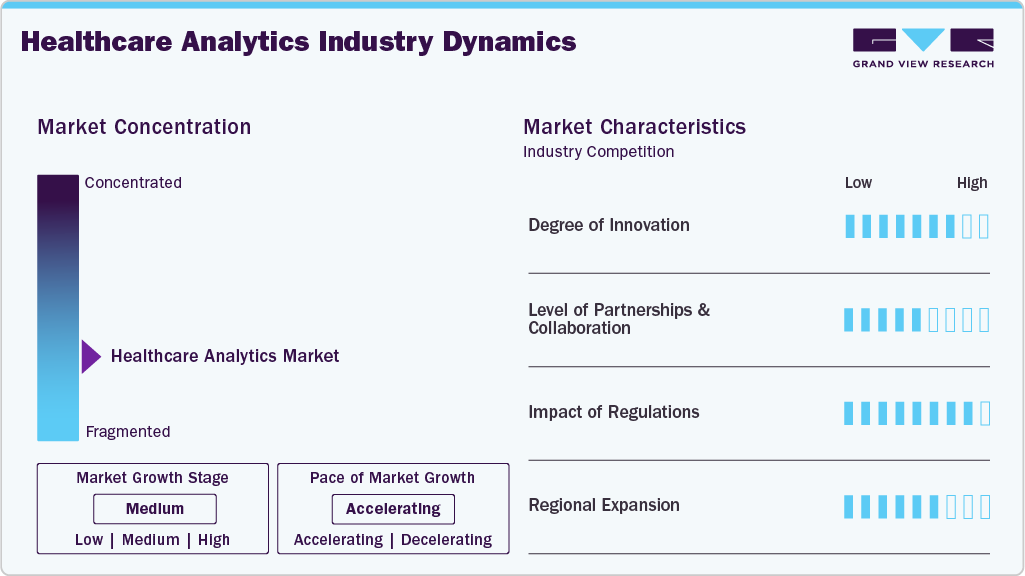
The level of partnerships and collaboration activities in the healthcare analytics industry is high, reflecting the sector’s emphasis on interoperability, advanced data sharing, and accelerating innovation to support value-based care. For instance, in June 2025, Mathematica and Tuva Health announced a partnership to improve healthcare data analytics for government and public health agencies by combining Mathematica’s advanced algorithms with Tuva Health’s open-source data model. This collaboration enables faster, higher-quality insights, empowering agencies to make evidence-based decisions and further strengthening the role of partnerships in shaping the future of U.S. healthcare analytics.
The impact of regulations on the global healthcare analytics industry is significant, as countries adopt various policies to manage data privacy, interoperability, and digital health adoption. Frameworks such as the EU’s General Data Protection Regulation (GDPR), data localization laws in Asia-Pacific, and international standards, such as ISO standards for health IT, influence how data is stored, accessed, and analyzed. While these regulations improve trust, transparency, and patient rights, the differences across regions increase complexity for multinational healthcare organizations, often necessitating tailored compliance strategies that raise costs but also promote investment in secure, interoperable analytics platforms.
The healthcare analytics industry is witnessing growth across various regions, driven by the rising adoption of electronic health records (EHRs), growing demand for predictive and prescriptive analytics in clinical and operational settings, and government initiatives promoting digital health transformation. In addition, favorable regulatory approvals and strategic partnerships between global manufacturers and local distributors are accelerating market penetration.

Type Insights
The descriptive analysis segment led the market with the largest revenue share of 45.4% in 2025. Descriptive analytics has been widely used during the pandemic to study historical data and patient histories to study the spread of the virus, which has been a key factor driving growth in this segment. Descriptive analytics has proved to be a valuable tool for understanding what happened by accessing historical data and turning it into actionable insights. In addition, hospitals are using it to monitor the performance of insurance claims by detecting irregularities and errors in the claims. Many organizations are using descriptive analysis tools to increase market growth potential.
The predictive analysis segment is anticipated to grow at a significant CAGR during the forecast period, as it uses datasets generated by descriptive analytics to derive actionable insights for the future. More and more companies are launching purpose-built solutions that embed risk stratification, propensity scoring, and next-best-action capabilities into clinical, payer, and consumer engagement workflows. For instance, in May 2024, mPulse announced the launch of its integrated predictive analytics and omnichannel engagement solution, marking a new category in digital health by enabling personalized digital interventions aligned with AI-powered predictive models.
Component Insights
The services segment led the market with the largest revenue share of 38.1% in 2025 and is projected to reach at the fastest CAGR during the forecast period. The healthcare industry has invested heavily in IT to develop platforms and digitize data for analytics. Most companies require a data analytics component and are outsourcing this part of their IT. As a result, data analytics companies offering comprehensive services have grown, expanding the segment. Increased patient load and rising disease prevalence have generated large amounts of clinical data. This puts pressure on the industry to provide better care, improved outcomes, and cost-effective treatments, driving market growth. The need to adopt analytical tools for better patient monitoring and enhanced treatment is a key driver of this segment's growth.
The hardware segment is expected to grow at a significant CAGR over the forecast period. This is due to the increasing deployment of high-performance servers, data storage systems, and networking infrastructure required to manage large volumes of healthcare data. Rising adoption of AI-powered analytics, cloud computing, and real-time patient monitoring solutions is further driving demand for advanced hardware systems across healthcare organizations. In addition, the growing use of connected medical devices and IoT-enabled healthcare infrastructure is supporting the expansion of the hardware segment.
Delivery Mode Insights
The on-premises segment led the market with the largest revenue share of 46.3% in 2025. Most institutions are currently installing software and tools to store data at their premises due to the ease of access and security, resulting in a large market share of this type of delivery. Current systems in small organizations are practical, but when scaled up, they can take time and effort to manage data when dealing with large datasets. This can entail a significant capital investment in data storage and security.
The cloud-based segment is projected to grow at the fastest CAGR of 15.0% over the forecast period, driven by ease of storage, lower capital investment, and increased flexibility and efficiency; these factors also support continued growth in this delivery mode. Cloud-based storage can also be on-premises, but the issue of scalability comes into the picture, even though public cloud storage solutions are a key factor for the growth of cloud-based storage solutions, becoming the fastest-growing sub-segment. Limitations of the same include reduced privacy and increased security concerns about data loss.
Application Insights
The financial segment accounted for the largest market revenue share in 2025 and is expected to grow at the fastest CAGR during the forecast period. Healthcare institutions and organizations are continually striving to minimize the cost of treatment while delivering better care to patients, attributed to the growth of this segment. Thus, companies perform better by reducing costs and preventing fraud.
The healthcare institutions incur costs in the form of insurance claims, which can also be fraudulent. To mitigate such risks and minimize such occurrences, healthcare organizations deploy analytical tools for predictive and descriptive analysis to deliver better care to patients, reduce the overall costs of operations, and minimize fraud in insurance claims. The need to perform financially well has been a key driver for adopting this application type.
End Use Insights
The life science companies segment led the market with the largest revenue share of 40.6% in 2025. Currently, the largest users of analytical tools and platforms are life-science companies, which use them to reduce product costs, increase profit margins, produce better products, and drive faster adoption and growth in the segment. Companies continually invest in improving their product portfolios and offerings to better serve a wider audience. This creates a need for analytical tools to better understand and predict the market and to drive value-based decisions.
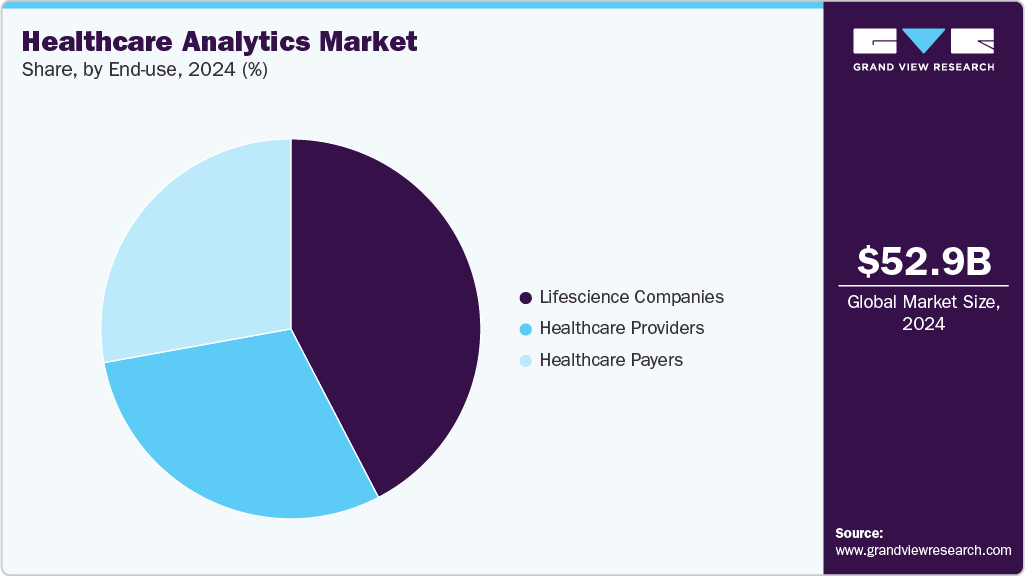
The healthcare providers segment is anticipated to grow at the fastest CAGR during the forecast period. Rising pressure on hospitals and care teams to deliver cost-effective care and improve patient management is driving this segment. The growing need to manage patient records, track diseases, and provide affordable care is accelerating adoption of healthcare analytics and is expected to support further segment growth.
Regional Insights
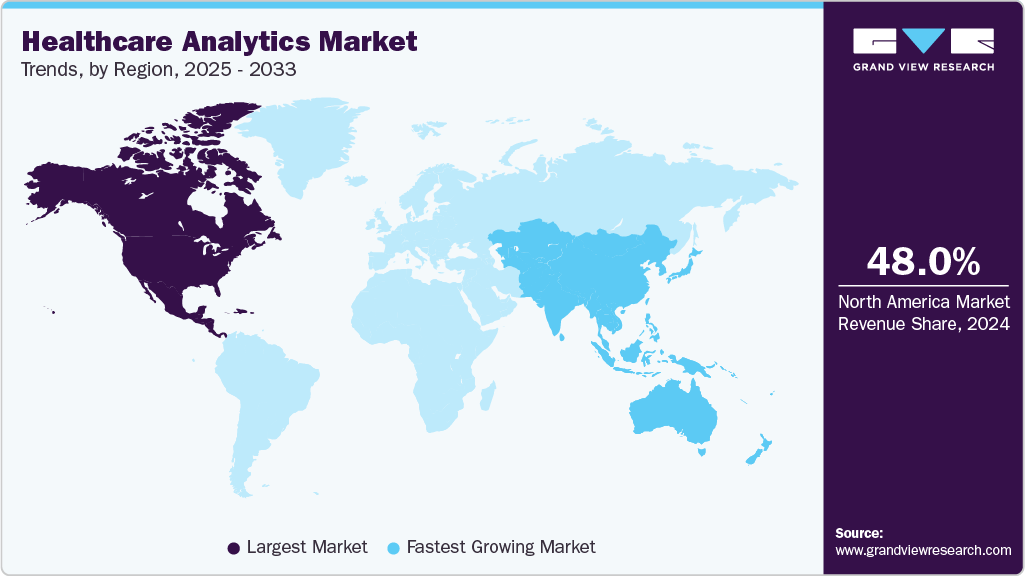
North America dominated the global healthcare analytics market with the largest revenue share of 47.5% in 2025. The region has state-of-the-art healthcare facilities, and the adoption of these platforms and better technological availability. Moreover, the rising burden of chronic illnesses and an aging population have created a need for hospitals and other organizations to adopt analytics tools. In addition, the presence of key players has also been a factor in the large market revenue share. In March 2022, Microsoft launched Microsoft Cloud for Healthcare, a collaboration between patients and providers to deliver better insights into patient care.
U.S. Healthcare Analytics Market Trends
The healthcare analytics market in the U.S. accounted for the largest market revenue share in North America in 2025, owing to the strong presence of key market players, advanced healthcare IT infrastructure, and growing government support for digital health adoption. Increasing investments in healthcare digitization, interoperability, and AI-enabled technologies are further accelerating market growth. In October 2023, the U.S. FDA established the Digital Health Advisory Committee to address scientific and technical challenges associated with digital health technologies, including AI and machine learning (AI/ML). Such initiatives are expected to support the broader integration of digital technologies in healthcare, thereby driving demand for healthcare analytics solutions.
Europe Healthcare Analytics Market Trends
The healthcare analytics market in Europe is driven by increased EHR adoption, rising demand for value-based care, and strong regulatory frameworks that focus on data privacy and interoperability. EU initiatives such as the Data Governance Act, the Data Act, and the European Health Data Space (EHDS) are key to this expansion, aiming to unify and simplify access to health data across the continent to support research, innovation, and data-driven healthcare. Although challenges related to privacy, technical integration, and intellectual property persist, effective implementation is expected to improve collaboration among patients, providers, governments, and industry, boosting the region’s healthcare analytics capabilities.
The UK healthcare analytics market is expanding rapidly, driven by NHS digital transformation, strong government support, and increasing adoption of AI and predictive analytics. Alongside public initiatives, industry-academia collaborations are advancing innovation; for instance, in June 2024, SAS and the Maxwell Center at the University of Cambridge announced a partnership to integrate the SAS Viya AI and analytics platform into the university environment, encouraging collaboration with researchers and startups.
The healthcare analytics market in Germany is growing steadily, supported by strong government initiatives to digitize healthcare, rising adoption of electronic health records under the Digital Healthcare Act (DVG), and increasing demand for AI-driven solutions to improve efficiency and patient outcomes.
Asia Pacific Healthcare Analytics Market Trends
The healthcare analytics market in the Asia Pacific is anticipated to register at the fastest CAGR of 15.2% during the forecast period. Fast development, greater spending capacity, and a growing population have all contributed to the rapid growth in APAC. There has been significant growth and advancements in the industry in this region, which has also contributed to its growth. The reliance of consumers and healthcare providers on IT has been increasing; thus, the adoption rates in the analytics sector have also increased. Australia-based healthcare analytics start-up Prospection has opened an office in Japan and will collaborate with international pharma customers to develop new treatments for the Japanese population.
The Japan healthcare analytics market is experiencing steady growth, fueled by government-led digital health initiatives, increasing adoption of electronic medical records, and a rising demand for AI-driven solutions to enhance care quality and efficiency. In March 2023, Fujitsu introduced a new cloud-based platform in Japan designed to securely collect, combine, and analyze health-related data from electronic medical records and personal health devices. Supporting the HL7 FHIR standard, the platform enables personalized healthcare, drug development, and the creation of a digital health ecosystem powered by AI and IoT, demonstrating Japan’s dedication to advancing healthcare analytics and precision medicine.
The healthcare analytics market in China is expanding rapidly, supported by large-scale government investments in healthcare digitization, the growing adoption of electronic health records, and a strong policy focus on AI integration through initiatives such as “Healthy China 2030.” Rising demand for predictive analytics, population health management, and precision medicine is driving adoption among hospitals and research institutions.
Latin America Healthcare Analytics Market Trends
The healthcare analytics market in Latin America is growing steadily, driven by increasing healthcare digitization, rising adoption of electronic health records, and government initiatives to improve care delivery and cost efficiency. Countries such as Brazil and Argentina are leading the adoption of AI-powered analytics platforms to strengthen population health management, optimize hospital operations, and support value-based care.
Middle East & Africa Healthcare Analytics Market Trends
The healthcare analytics market in the Middle East & Africa is growing, driven by government-led digital health initiatives, the increasing use of AI and predictive analytics, and efforts to modernize healthcare infrastructure. While GCC countries such as the UAE and Saudi Arabia are at the forefront of adoption, African markets are slowly progressing through population health and telehealth projects, supported by public-private partnerships despite challenges related to infrastructure and costs.
Key Healthcare Analytics Company Insights
Key industry players are adopting different strategies, constantly innovating and introducing new technologies to better analyze data derived from patient information, understand the spread and containment of disease, and deliver better care solutions to healthcare providers and institutions. Using big data analytics and AI has also led to new platforms for better understanding and analyzing data.

Key Healthcare Analytics Companies:
The following key companies have been profiled for this study on the healthcare analytics market.
- McKesson Corporation
- Optum, Inc.
- Merative (formerly IBM Watson Health)
- Oracle
- SAS Institute, Inc.
- IQVIA
- Verisk Analytics, Inc.
- Elsevier
- Medeanalytics, Inc.
- Veradigm
- Cognizant Technology Solutions
- Infor, Inc. (Koch Industries)
- Wipro Limited
- Infosys Limited
- Health Catalyst, Inc.
- Athenahealth, Inc. (Veritas Capital)
- Komodo Health
Competitive Benchmarking
Operating Strategies
Competitive Edge
Weaknesses
Mature Players: Microsoft Corporation, Google LLC, Amazon Web Services Inc., Automation Anywhere Inc.
- Mature players are increasingly investing in agentic AI orchestration, enterprise automation, and cloud-native multi-agent platforms to strengthen large-scale operational capabilities.
- Leading vendors are expanding partnerships with hyperscalers, enterprise software providers, and AI infrastructure companies to accelerate autonomous system deployment.
- Established companies benefit from strong enterprise ecosystems, extensive cloud infrastructure, and broad customer bases across global industries.
- Mature players possess stronger financial capabilities and R&D resources to support advanced AI model development and enterprise-scale deployments.
- Large organizations often face integration complexity and slower deployment cycles due to legacy infrastructure and enterprise-scale operational structures.
- High operational costs, governance requirements, and increasing regulatory scrutiny may limit deployment flexibility across certain enterprise environments.
Emerging Players: Anthropic PBC, Kore.ai Inc., LangChain Inc., CrewAI Inc.
- Emerging companies are focusing on specialized AI agent frameworks, workflow automation tools, and niche enterprise use cases to differentiate their offerings.
- Startups are increasingly emphasizing low-code AI agent development, decentralized AI architectures, and industry-specific automation platforms to gain market traction.
- Smaller vendors often demonstrate faster innovation cycles and greater flexibility in deploying customized autonomous AI solutions.
- Emerging players can rapidly adapt to evolving enterprise AI demands and integrate new generative AI capabilities more efficiently.
- Emerging companies frequently face limitations in computing infrastructure, enterprise reach, and long-term scalability capabilities.
- Limited financial resources and lower brand recognition may restrict their ability to compete with established technology providers in large enterprise contracts.
Recent Developments
-
In February 2026, Hexaware Technologies partnered with CareInsight to accelerate AI-driven healthcare transformation through integrated healthcare analytics and automation platforms. The collaboration focuses on deploying scalable AI solutions for patient engagement, care management, administrative automation, and real-time analytics to improve operational efficiency, clinical decision-making, and healthcare outcomes. The partnership also supports secure and regulatory-compliant AI adoption across healthcare organizations.
"Our partnership with CareInsight reflects Hexaware's commitment to move beyond technology modernization toward outcome-driven transformation. Together, we will help payers and providers operationalize AI at scale, accelerate value-based, equitable care, and deliver measurable, real-world impact for our customers.
- Shantanu Baruah, President & Global Head - Healthcare, Life Sciences & Insurance, Hexaware
-
In June 2025, Kythera Labs announced strategic partnerships with healthcare analytics firms Preverity and GAM to provide advanced data integration, de-identification, and data mastering services through its Wayfinder Platform. This collaboration enables secure, compliant, and comprehensive healthcare analytics that improve patient safety, risk management, and operational efficiency.
“These partnerships demonstrate the critical need for robust data infrastructure in healthcare analytics. We're providing the essential data backbone that enables Preverity and GAM to focus on what they do best delivering specialized analytics insights while we handle the complex challenges of data integration, privacy protection, and data quality management."
-Jeff McDonald, CEO and Co-Founder of Kythera Labs.
-
In December 2024, Tuva Health launched the world's first open-source healthcare data transformation platform with USD 5 million in seed funding. The platform enables payers, providers, and pharmaceutical companies to transform claims and EHR data into analytics-ready tables, promoting transparency, scalability, and collaborative innovation to improve patient care and operational efficiency.
“Healthcare organizations have lacked a flexible, scalable, and transparent analytics solution to enhance patient outcomes and improve operational efficiency, Tuva Health’s model addresses this need, providing a comprehensive solution that meets the growing demand for innovation in healthcare.”
- Sean Doolan, Founder and Managing Partner of Virtue.
-
In May, 2024, Aetion launched Aetion Discover, a new application that provides fast, reliable, and scalable descriptive analytics for healthcare data, enabling users to generate swift hypotheses and insights across biopharmaceutical and medtech lifecycles. It offers speed, auditability, compatibility, and an intuitive interface to support data-driven decision-making.
“Time and time again, we heard our customers' interest in expanding our technology toward 'everyday insights,' and, importantly, for this [visual] exploration work to readily extend into advanced evidence generation when needed. We're glad to bring our software to a wider set of use cases, to create essential insights and efficiencies across user groups. Like all Aetion offerings, Discover is based in the latest and best science and works across a wide range of real-world data”
- Dr. Jeremy Rassen, Aetion president, co-founder, and chief technology officer.
-
In August 2022, Syntellis Performance Solutions acquired Stratasan, an advanced healthcare market intelligence and data analytics company. This acquisition helps Syntellis Performance Solutions expand its solution or software portfolio for healthcare organizations with data and intelligence solutions to improve financial, strategic, and operational growth planning.
“By adding Stratasan’s powerful strategic growth capabilities to our suite of intelligent planning and performance products, Syntellis will empower more healthcare organizations with best-in-class data and intelligence solutions to improve operational, financial and strategic growth planning so they can ensure future success and stability.”
-Flint Brenton, CEO of Syntellis
Healthcare Analytics Market Report Scope
Report Attribute
Details
Market size value in 2026
USD 81.9 billion
Revenue forecast in 2033
USD 198.8 billion
Growth rate
CAGR of 13.5% from 2026 to 2033
Base year for estimation
2025
Historical data
2021 - 2024
Forecast period
2026 - 2033
Quantitative units
Market value in USD million/billion, and CAGR from 2026 to 2033
Report coverage
Revenue forecast, company ranking, competitive landscape, growth factors, and trends
Segments covered
Type, component, delivery mode, application, end use, region
Regional scope
North America; Europe; Asia Pacific; Latin America; Middle East & Africa
Country scope
U.S.; Canada; Mexico; Germany; UK; France; Italy; Spain; Norway; Denmark; Sweden; China; Japan; India; South Korea; Australia; Thailand; Brazil; Argentina; Saudi Arabia; South Africa; UAE; and Kuwait
Key companies profiled
McKesson Corporation; Optum, Inc.; Merative (formerly IBM Watson Health); Oracle; SAS Institute, Inc.; IQVIA; Verisk Analytics, Inc.; Elsevier; MedeAnalytics, Inc.; Veradigm; Cognizant Technology Solutions; Infor, Inc. (Koch Industries); Wipro Limited; Infosys Limited; Health Catalyst, Inc.; Komodo Health; Athenahealth, Inc. (Veritas Capital)
Customization scope
Free report customization (equivalent up to 8 analysts working days) with purchase. Addition or alteration to country, regional & segment scope.
Pricing and purchase options
Avail customized purchase options to meet your exact research needs. Explore purchase options
Global Healthcare Analytics Market Report Segmentation
This report forecasts revenue growth at global, regional, and country levels and provides an analysis of the latest industry trends in each of the sub-segments from 2021 to 2033. For this study, Grand View Research has segmented the global healthcare analytics market report based on type, component, delivery mode, application, end use, and regions:
-
Component Outlook (Revenue, USD Million, 2021 - 2033)
-
Software
-
Clinical Analytics Software
-
Financial Analytics Software
-
Operational & Administrative Analytics Software
-
Population Health Analytics Software
-
Predictive & Prescriptive Analytics Software
-
AI & Machine Learning-based Analytics Platforms
-
Revenue Cycle Analytics Software
-
Claims & Fraud Analytics Software
-
Patient Engagement Analytics Solutions
-
Real-time Analytics Platforms
-
-
Hardware
-
Servers & High-performance Computing Systems
-
Data Storage Systems
-
Networking Infrastructure
-
Edge Computing Devices
-
AI Acceleration Hardware (GPU/TPU Systems)
-
Healthcare IoT & Connected Monitoring Devices
-
On-premise Analytics Infrastructure Systems
-
-
Services
-
Consulting Services
-
Implementation & Integration Services
-
Training & Support Services
-
Managed Analytics Services
-
Interoperability & Integration Services
-
Others (Custom Analytics Development Services, etc.)
-
-
-
Type Outlook (Revenue, USD Million, 2021 - 2033)
-
Descriptive Analysis
-
Diagnostic Analytics
-
Predictive Analysis
-
Prescriptive Analysis
-
-
Delivery Mode Outlook (Revenue, USD Million, 2021 - 2033)
-
On-premises
-
Web-hosted
-
Cloud-based
-
-
Application Outlook (Revenue, USD Million, 2021 - 2033)
-
Clinical
-
Financial
-
Operational and Administrative
-
-
End Use Outlook (Revenue, USD Million, 2021 - 2033)
-
Healthcare Payers
-
Healthcare Providers
-
Life Science Companies
-
-
Regional Outlook (Revenue, USD Million, 2021 – 2033)
-
North America
-
U.S.
-
Canada
-
Mexico
-
-
Europe
-
UK
-
Germany
-
France
-
Italy
-
Spain
-
Denmark
-
Sweden
-
Norway
-
-
Asia Pacific
-
China
-
Japan
-
India
-
South Korea
-
Australia
-
Thailand
-
-
Latin America
-
Brazil
-
Argentina
-
-
Middle East and Africa (MEA)
-
South Africa
-
Saudi Arabia
-
UAE
-
Kuwait
-
-
Delivered Customizations
This report has been delivered with the following In-depth customizations
Client Request
Customization Delivered
Value Adds
Competitive Landscape
Conducted detailed competitive analysis, including company-level market share estimation across key regions (North America, Europe, Asia-Pacific, Latin America, and MEA). Developed a structured company evaluation matrix categorizing companies into Leaders, Visionaries, Emerging Players, and Niche Players based on product portfolio strength, technological capabilities, geographic presence, and strategic initiatives.
Enables clear identification of market leaders and challengers by region, supports benchmarking of company performance across key parameters, and assists in strategic decision-making for competitive positioning, expansion planning, and partnership opportunities.
Pricing & Business Model Analysis
Conducted comparative analysis of subscription models, SaaS pricing, enterprise licensing, and value-based pricing strategies adopted by competitors.
Helps optimize pricing structure and revenue generation strategy.
Implementation Cost & Return on Investment (ROI) Benchmarking
Benchmarked implementation timelines, integration costs, staffing requirements, ROI realization periods, and operational efficiency gains associated with healthcare analytics deployment.
Assists in developing stronger value propositions and customer ROI models.
Frequently Asked Questions About This Report
The global healthcare analytics market size was estimated at USD 65.6 billion in 2025 and is expected to reach USD 81.9 billion in 2026.
The global healthcare analytics market is expected to grow at a compound annual growth rate of 13.5% from 2026 to 2033 to reach USD 198.8 billion by 2033.
Descriptive analytics dominated the healthcare analytics market, with a share of 45.4% in 2025. Descriptive analytics has been widely used during the pandemic to study historical data and patient histories to study the spread of the virus, which has been a key factor driving growth in this segment
Some key players operating in the healthcare analytics market include McKesson Corporation, Optum, Inc., Merative (formerly IBM Watson Health), Oracle, SAS Institute, Inc., IQVIA, Cognizant Technology Solutions, Infor, Inc. (Koch Industries), Wipro Limited, Infosys Limited, Health Catalyst, Inc., Komodo Health, Elsevier, MedeAnalytics, Inc., Veradigm, Athenahealth, Inc. (Veritas Capital), and Verisk Analytics, Inc.
Key factors that are driving the healthcare analytics market growth include the pressure to curb healthcare costs, the emergence of advanced analytics methods, the growing demand for personalized medication and treatment, and the rising impact of the internet and social media on healthcare.
About the authors:
Author: GVR Healthcare IT Research Team | Last Updated:


Share this report with your colleague or friend.
Need a Tailored Report?
Customize this report to your needs — add regions, segments, or data points, with 20% free customization.


ISO 9001:2015 & 27001:2022 Certified
We are GDPR and CCPA compliant! Your transaction & personal information is safe and secure. For more details, please read our privacy policy.












